
Roads, Regret, and the Fight to Fix Idaho’s Deadliest Wildlife Gauntlets
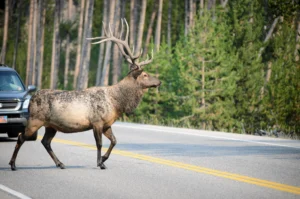
Traffic zips in each direction on Idaho’s Highway 33. On any given afternoon, you will see early-season visitors heading out to dinner alongside locals driving back over Teton Pass after a long day of work in Jackson. It is seemingly always busy these days—a relentless gauntlet for both cars and wildlife.
For those navigating these roads, the danger is invisible until it is too late. But for a growing group of volunteers and conservationists, the evidence of our fractured landscapes is lying right on the shoulder of the asphalt.
1. The Grim Reality of Highway 33: A Firsthand Look at the Crisis
To the north, just across the road, a carcass sits slumped behind the guardrail. Led by Renee Seidler, executive director of the Jackson Hole Wildlife Foundation, a group of volunteers steps across the lanes to inspect the animal.
Armed with notebooks and medical gloves, the team moves the carcass away from the pavement to begin a somber examination:
Species: Mule Deer
Sex: Female
Age: Juvenile
Cause of Death: Vehicle collision
This isn’t just an isolated tragedy; it is a data point. These volunteers are training for a rigorous roadkill survey on the stretch of Highway 33 between Victor and the Wyoming state line. Their goal is to gather the hard evidence needed to prove that a dedicated wildlife crossing must be built here.
2. The Power of Wildlife Crossings: Engineering Safer Corridors
Collisions between cars and wildlife do more than just threaten human safety—they carry massive economic impacts, cause needless animal deaths, and completely block critical migration paths. Fortunately, we already have a proven solution.
Well-designed, thoughtfully placed wildlife crossings paired with high exclusionary fencing can effectively slash wildlife-vehicle collisions by up to 97 percent. They stand out as one of the single best tools available to keep drivers safe while ensuring animals can navigate their natural habitats without running a gauntlet of steel and rubber.
3. The 2025 Cramer Report: Data-Driven Priorities for Eastern Idaho
Wildlife crossings are expensive infrastructure investments. Naturally, transportation agencies, community leaders, and funders want absolute certainty that they are being built in the most effective areas. To make these decisions, experts rely heavily on carcass data, crash numbers, wildlife migration tracking, and the presence of protected public land on both sides of the highway.
A groundbreaking report released in the fall of 2025 did exactly that heavy lifting. Written by renowned road ecologist Dr. Patricia Cramer, the report mapped out and prioritized exactly where the Idaho Transportation Department should build crossings. The findings were crystal clear: the vast majority of the top 20 highest-priority sites in the state are located right in the Greater Yellowstone Ecosystem’s sliver of eastern Idaho. Interestingly, the very section of Highway 33 currently being surveyed by volunteers ranked right at number 20.
4. The Battle for US 20: Protecting a Critical Migration Corridor
Dr. Cramer’s report strongly validated what the Greater Yellowstone Coalition (GYC) has been advocating for over many years. GYC has long pushed for infrastructure on US 20 to mitigate collisions and patch up fragmented habitats.
According to the data, the absolute highest-scoring segment in the entire state is the 16-mile stretch of US 20 from Ashton to Harriman State Park. This specific highway cuts straight through thick coniferous forests and open meadows—habitats that host vital ungulate migrations moving from Island Park and the western edge of Yellowstone National Park down to their winter ranges in the Sand Creek Desert. Along the wider 45-mile stretch of US 20 to the Montana line, three other sections also landed squarely on the priority list, highlighting a desperate need to safeguard the entire corridor.
5. The Legislative Milestone: A First-of-Its-Kind Resolution
While the ecological data speaks for itself, true progress requires political will. This past spring, thanks to the persistent encouragement and advocacy of Idaho’s sporting and conservation communities, the Idaho Legislature took a historic step forward by passing Senate Concurrent Resolution 124.
This first-of-its-kind resolution states that the legislature strongly supports advancing public safety and big game conservation by implementing wildlife crossings. It serves as a massive milestone, signaling that lawmakers are finally recognizing the profound importance of reconnecting Idaho’s fragmented landscapes.
6. The Human Factor: Why Community Support Makes or Breaks a Project
Despite the legislative wins and the clear scientific data, one massive variable remains: the local community. The text of Senate Concurrent Resolution 124 explicitly notes that crossings should be developed where they are “supported by local communities”.
That clause carries immense weight. In the past, fierce community opposition completely derailed planned crossings on US 20—a stark reminder that human advocacy is just as critical as ecological data. Building the momentum required to break ground on a single project can turn into a decades-long march of research, education, and grassroots outreach to ensure locals are entirely on board.